
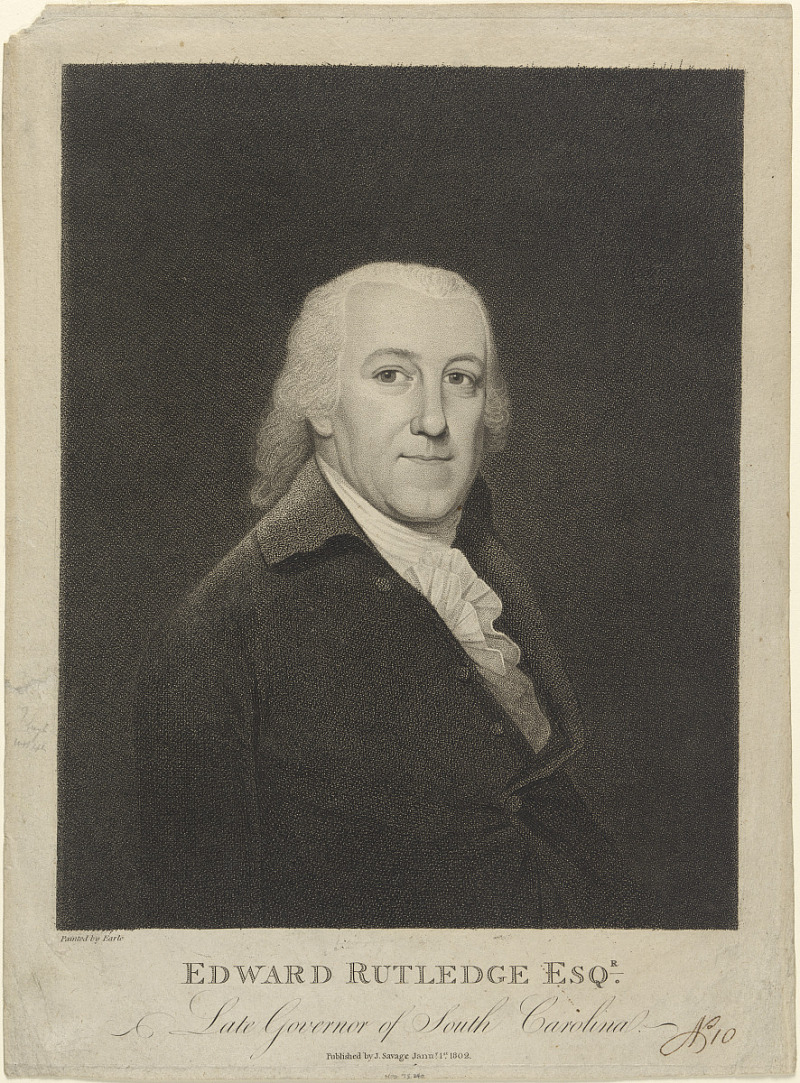
Birth Date: November 23, 1749
Birthplace: Charlestown, South Carolina
State Represented: South Carolina
Occupation: Lawyer, planter
Age at Signing: 26
Death: January 23, 1800; at the age of 50
Quote: “I always considered an idle Life, as a real evil, but, a life of such hurry, such constant hurry, leaves us scarcely a moment for reflection or for the discharge of any other then the most immediate and pressing concerns.”
Summary: To learn more about Edward Rutledge, keep reading!

Mackenzie Hope is a young writer who loves finding the Lord in the most unlikely circumstances. When not writing, she enjoys playing music, reading, and going on adventures in God’s creation.
Edward Rutledge
by Mackenzie Hope
I have no idea how to write an article for a blog. I’ve only ever written nonfiction for school. None of it had a purpose, other than to receive a decent grade.
I want this to be different.
I did some research on Edward Rutledge. I learned about his background, how he went to law school in England and signed the Declaration of Independence at age 26. I learned how he was captured in battle in the Revolutionary War and set free a year later. But what does any of that mean? Why should I care? Why should you care?
What does this have to do with writing a blog article?
Did you know Edward Rutledge didn’t initially want to sign the Declaration? He had a habit of avoiding opinions that would be seen as radical or extreme. He only changed his mind about independence after an initial trial vote in which his state, South Carolina, voted “no”. Hoping to make the final vote unanimous among the colonies, he immediately met with the other delegates from South Carolina and convinced them to vote “yes”. A month later, Rutledge was the youngest signer of the Declaration.
The point is: Rutledge clearly wasn’t sure about the right course of action. And yet he took a chance on an idea he had previously deemed “. . .the reason of every Madman. . .” And, I don’t know about you, but as a teenager living in 21st century America, with the freedom to go to church and the freedom to write this article, I think he made the right decision.
When I learned about Rutledge’s story, it drew me back to one of my favorite stories from the Bible: when God first called Moses to lead His people out of Egypt. The Lord appeared brilliantly to Moses in a burning bush, telling Moses that He had heard the cry of his people and wanted Moses to speak to Pharaoh, ruler of Egypt. Moses hid his face in fear and questioned his God. “‘But behold, they will not believe me or listen to my voice’” (Ex. 4:1, ESV). It took nearly a whole chapter for the Lord to convince Moses to obey. (You can read the whole story for yourself in Ex. 3:1 – 4:31.)
While I can’t be certain, I think that in 1776, Rutledge was feeling a bit like Moses. But his story, like Moses’ reminds us that the Lord has a plan. That plan often sounds like madness. But it’s His plan, and it’s good. Sometimes we have to step out in faith, even if we’re not sure what the results will be.
Then the angel of God who was going before the host of Israel moved and went behind them, and the pillar of cloud moved from before them and stood behind them, coming between the host of Egypt and the host of Israel. And there was the cloud and the darkness. And it lit up the night without one coming near the other all night.
“Then Moses stretched out his hand over the sea, and the Lord drove the sea back by a strong east wind all night and made the sea dry land, and the waters were divided. And the people of Israel went into the midst of the sea on dry ground, the waters being a wall to them on their right hand and on their left. The Egyptians pursued and went in after them into the midst of the sea, all Pharaoh’s horses, his chariots, and his horsemen. And in the morning watch the Lord in the pillar of fire and of cloud looked down on the Egyptian forces and threw the Egyptian forces into a panic. . . The waters returned and covered the chariots and the horsemen; all the host of Pharaoh that had followed them into the sea, not one of them remained.” (Ex. 14:19-24, 28.)
Leave a Reply