
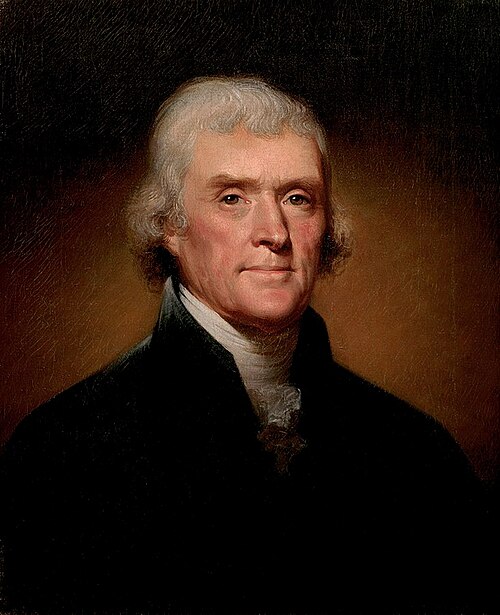
Birth Date: April 2, 1743
Birthplace: Shadwell, Virginia
State Represented: Virginia
Occupation: Planter and Politician
Age at Signing: 33
Death: July 4, 1826 at age 33
Quote: “Do you want to know who you are? Don’t ask. Act! Action will delineate and define you.”
Summary: To read a rich historical account of Thomas Jefferson, keep reading. 🙂

E. A. Weir has been writing since before she can remember. She favors fiction, especially fantasy, but can write a good essay when the situation calls for it. Her favorite book series is The Blades of Acktar by Tricia Mingerink. She enjoys music, both creating and listening to it, and loves to wander in the outdoors. The Founding Fathers are her favorite historical period to study; Thomas Jefferson especially interests her. E. A.’s dream is to work as a statistician while writing on the side.
Thomas Jefferson: Pen of the Revolution
by E. A. Weir
Margaret Thatcher, Prime Minister of England, said of Thomas Jefferson, “[I]n the history of liberty, he’s a great figure everywhere in the world.” Jefferson is a fascinating man who has been both praised and denigrated over the course of history. He is best known for writing the Declaration of Independence, although at the time few knew he was the main author. He was a lawyer, a legislator, a governor, a president, a vice president, a Secretary of State, a minister of foreign affairs, a landowner, a husband, a father, and more during his eighty-three years of life. He was a Christian, although today he is called one of the least religious of the Founding Fathers. In the words of David Barton:
“[H]e did not give Gospel altar calls in the courtroom like Thomas McKean. Nor did he call his state to prayer on twenty-two separate occasions using Christ-centered language like John Hancock. And he did not start the Sunday school movement in America or help found its first Bible society, as Benjamin Rush did.… Jefferson certainly did not do in the religious realm what many others of his fellow signers did, so he truly is one of the ‘least’ religious among that group; but this definitely does not mean that he was non- or anti-religious,…” (Barton, 23-24)
Jefferson’s reputation has taken many hits in recent years, but historically he has been praised universally worldwide. According to David Barton, he has been called “Apostle of Liberty,” “Man of the People,” “Pen of the Revolution,” “Father of the Declaration of Independence,” “The Defender of the Rights of Man and the Rights of Conscience,” the “Sage of Monticello,” and “The Apostle of Democracy.” He is a fascinating figure with a long and complicated career.
Jefferson grew up in Virginia, on what was the frontier at the time, in Peter Jefferson’s plantation, Shadwell, and the nearby Randolph plantation, Tuckahoe. He attended the College of William and Mary. He began his career as a lawyer but later found his true calling as a politician. On January 1, 1772, he married widowed Martha Wayles Skelton. They had six children, two of whom survived to adulthood. He built Monticello a short distance from his boyhood home, on family property. He had a rather idealized vision of home, which was partially fulfilled when his daughter Martha and her family moved in with him in Monticello due to troubles with the husband’s family. “Home was a powerful idea for Thomas Jefferson, a fixed point in a sentimental geography formed from the melded associations of people, places, and events. When he was away from Monticello… he visualized his mountain as a paradise of domestic tranquility.”1 Despite his love for home and the high value he placed on home life, he spent relatively little time at Monticello, instead traveling to the national capital and overseas for the majority of his career.
At age thirty-three, he was one of the youngest delegates to the Second Continental Congress. He was the main author of the Declaration of Independence, along with John Adams, Benjamin Franklin, Robert R. Livingston, and Roger Sherman. Together, they made up the Committee of Five. However, according to Britannica, “he was not known by most Americans as the principal author until the 1790s.”2 His contribution was more to the founding of a new nation than to the course of the Revolution, but he was still a major figure in the war through his writings and political accomplishments.
He also served as both governor and state legislator of Virginia, and he “launched an extensive project for the reform of the state’s legal code to bring it in line with the principles of the American Revolution”3 upon returning there in 1776. He played a leading role in shaping U. S. foreign policy during his years as Minister to France, and he served under George Washington as the nation’s first Secretary of State and under John Adams as the second Vice President.
Thomas Jefferson served in many capacities throughout the American Revolution and the following years, while America was settling into its new role as a united country. He was a complex person and a fascinating figure to study. He may not have been a speaker, but he was a powerful writer, and his words in the famous Preamble to the Declaration of the Independence are still impactful today. He was a steadfast Christian and, as David Barton writes, “Jefferson’s actions in promoting religious activities in the public realm go far beyond what most religious folks today would ever consider doing.” The standards for religion and religious promotion in those days were much higher than those of today, and Jefferson lived up to them faithfully. He worked hard to achieve the vision he and the other Founding Fathers shared, that of “one nation, under God, indivisible, with liberty and justice for all.”
- Annette Gordon-Reed & Peter S. Onuf, Most Blessed of the Patriarchs, p. 27 ↩︎
- Britannica, “The Thomas Jefferson” ↩︎
- Britannica, “The Thomas Jefferson” ↩︎
Bibliography
Barton, David. The Jefferson Lies: Exposing the Myths You’ve Always Believed About Thomas Jefferson. Foreword by Glenn Beck, WND Books, 2016, Washington, D.C.
Ellis, Joseph J. “Thomas Jefferson.” Britannica, https://www.britannica.com/biography/Thomas-Jefferson.
Gordon-Reed, Annette, and Onuf, Peter S. Most Blessed of the Patriarchs: Thomas Jefferson and the Empire of Imagination. Liveright Publishing Corporation, 2016, New York, NY.
“Thomas Jefferson.” Wikipedia, https://en.wikipedia.org/wiki/Thomas_Jefferson
Quotes:
“[I]n the history of liberty, he’s a great figure everywhere in the world.” Margaret Thatcher, quoted in The Jefferson Lies, p. 5
“[H]e did not give Gospel altar calls in the courtroom like Thomas McKean. Nor did he call his state to prayer on twenty-two separate occasions using Christ-centered language like John Hancock. And he did not start the Sunday school movement in America or help found its first Bible society, as Benjamin Rush did.… Jefferson certainly did not do in the religious realm what many others of his fellow signers did, so he truly is one of the ‘least’ religious among that group; but this definitely does not mean that he was non- or anti-religious,…” David Barton, The Jefferson Lies, pp. 23-24
“Home was a powerful idea for Thomas Jefferson, a fixed point in a sentimental geography formed from the melded associations of people, places, and events. When he was away from Monticello… he visualized his mountain as a paradise of domestic tranquility.” Annette Gordon-Reed & Peter S. Onuf, Most Blessed of the Patriarchs, p. 27
“he was not known by most Americans as the principal author until the 1790s.” Britannica, “Thomas Jefferson,” subsection “Declaring independence”
“launched an extensive project for the reform of the state’s legal code to bring it in line with the principles of the American Revolution” Britannica, “Thomas Jefferson,” subsection “Declaring independence”
“Jefferson’s actions in promoting religious activities in the public realm go far beyond what most religious folks today would ever consider doing.” David Barton, The Jefferson Lies, p. 24
“one nation, under God, indivisible, with liberty and justice for all.” The Pledge of Allegiance
Note: The list of honorifics for Thomas Jefferson in paragraph two, while a paraphrase and not exactly a direct quote, is very close to the passage I paraphrased, from The Jefferson Lies, p. 2
Leave a Reply