
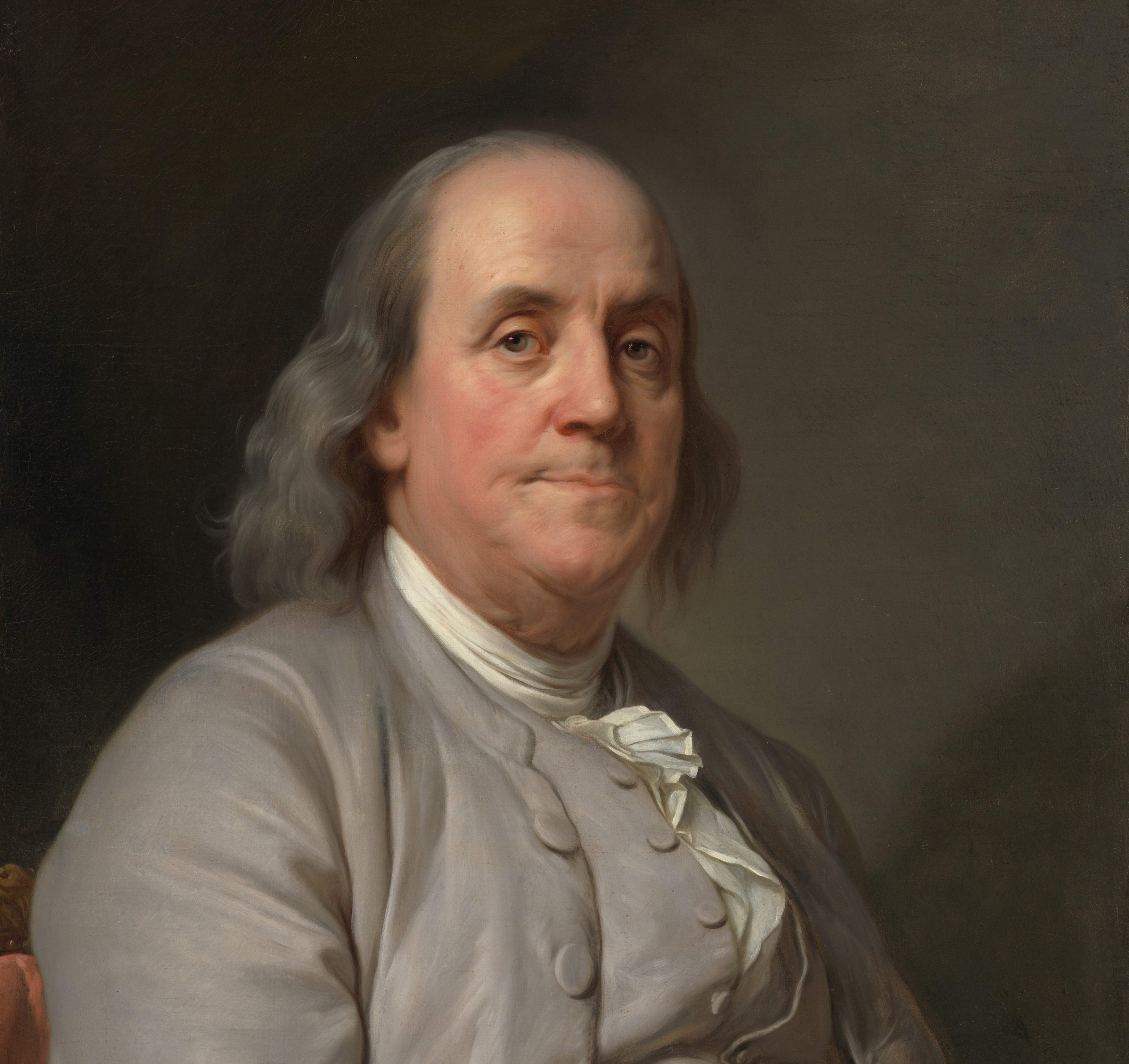
Birth Date: January 17, 1706
Birthplace: Boston, Massachusetts
State Represented: Pennsylvania
Occupation: Printer, Statesmen, Scientist
Age at Signing: 70
Death: April 17, 1790
Popular Quote: “Those who would give up essential liberty to purchase a little temporary safety, deserve neither liberty nor safety.”
Summary of Life: Benjamin Franklin was one of the key Founding Fathers of our country. He was the tenth of seventeen children of a candlemaker and found a love of the written word early on. At twelve and working for his brother’s paper, Mr. Franklin began slipping letters underneath the print shop for his brother to print, knowing that he would not publish them otherwise. These letters are now famously known as the Silence Dogood letters.
Through his life, Mr. Franklin was known for many things, especially his invention of the lightning rod, bifocals, and swim fins, but he is possibly most well-known for being one of the most foundational Founding Fathers. Mr. Franklin both drafted and signed the Declaration of Independence and the Constitution as well as spending one third of his life across seas in Europe in Great Britain and France as the first diplomat for the colonies, fighting for their freedom. He was a key member of the Continental Congress and was often the person to lighten the mood of the place with his witty comments and short catch-phrases.
Mr. Franklin lived a full and influential life, even touching the lives of us today, and it is hard to sum up his life in so few words. Abigail Adams said of Benjamin Franklin, “I thought I could read in his countenance the virtues of his hearts; among which patriotism shone in its full luster and with that is blended every virtue of a Christian; for a true patriot must be a religious man.” And that is what Benjamin Franklin truly was: a true patriot.

A True Patriot:
A SHORT STORY
FRANKLIN COURT, PHILADELPHIA, PENNSYLVANIA:
JULY 1, 1789
“Lost time is never found again,” Benjamin Franklin let out a heavy sigh, and Ruth glanced up at him, her fingers freezing from filtering through the papers. She glanced out the window to see the sun lowering itself over the horizon. How long had she been in thought?
“You sound as if you speak from experience,” she replied, pushing a wisp of brown hair out of her eyes.
“I am sure that it is the experience of all mankind,” he responded from his large chair.
Ruth was given one job: go through the papers that Mr. Franklin had and sort the mess into something coherent. She stood and walked over to his desk to lay down another of his letters.
“Sir, you have lived a life more full than anyone I have ever known,” Ruth smiled at him kindly. How often she had wanted to travel back in time to see this man in action.
“But how much of that life was spent for myself and my fellow countrymen when it could have been spent for Someone else,” he whispered and shook his head. “I once tried to write an autobiography of my life, but I’m afraid the pursuit is lost now.”
“Then tell me,” Ruth said, lifting a pen and journal she had been keeping to document papers. “Tell me all about it, about your life.”
“And about Providence’s work in my life,” Mr. Franklin chuckled and sat back in his chair, his eyes closing. “I had many notable moments in my life, many great inventions, but my greatest work was that of the freedom of our great nation. My story begins later in life than those letters, much later. 1776.”
Leave a Reply